
Sevier Parole and Probation
Parole and probation both allow a person to live outside a jail or prison while following set rules, but they begin in different ways. The Tennessee Board of Parole decides whether to grant parole to an eligible state prisoner. TDOC Community Supervision then oversees a parolee in the community. Probation comes from a court order. It may replace prison, follow a period of split confinement, or arise through a qualifying determinate-release path. TDOC supervises many Tennessee felony probation cases, including cases routed through its Sevierville field office.
A favorable parole decision is not the physical release itself. TDOC notes that a release plan and other prerequisites may need approval before an institution completes the release. A probation order also does not supply the jail's door-out time. For a sound Sevier County supervision check, compare the court or Board authority with FOIL status information and, when needed, the supervising office's record.
| Point | Parole | Probation |
|---|---|---|
| Who authorizes it | Tennessee Board of Parole after an eligible state sentence | The sentencing court, or a qualifying statutory release process |
| What it follows | State confinement | It may replace confinement or follow county jail or split confinement |
| Public first check | TDOC FOIL status and Board records | TDOC FOIL for covered felonies and the originating court file |
| Local state contact | TDOC District 20 Sevierville field office | |
- Parole
- Conditional release from a state sentence after Board action and TDOC release processing.
- Probation
- Court-ordered community supervision that may be imposed without a prison term or after confinement.
- Discharge
- The formal end of a custody or supervision obligation shown by the responsible agency's record.
- Absconder
- A person whom the supervising agency alleges stopped reporting or cannot be located.
Verify Sevier Post-Release Supervision
Use the system tied to the sentence. TDOC Felony Offender Information Lookup, known as FOIL, covers people currently or formerly in TDOC custody or supervision. Search modes include name, TDOC ID, and State ID. A name search permits an alias match and race filter, and the form requires a CAPTCHA. FOIL can display a photo, status, location, offense, sentence, parole-hearing details, and release information when those fields apply.
FOIL is not a general record of every Sevier County booking. A person held only on a misdemeanor or a pretrial case may never enter TDOC data. Court probation may instead be confirmed through the clerk maintaining the judgment. Follow this sequence:
- Match the full name and use a TDOC or State ID when available. Similar names alone are not enough.
- Read status and location separately. “Parole” or “probation” signals supervision, while “inactive” calls for review of the dates and case detail.
- Check the Board of Parole hearing division when a parole decision or pending hearing matters. A schedule is not a final decision.
- For probation based on a Sevier County judgment, obtain the court order and any later revocation, completion, or discharge entry.
- Call TDOC District 20 when the public fields leave the active Sevier County supervision status unclear.
The Sevier County released-inmate search path explains how the county release record, court order, and state status fit together. Those sources answer different parts of the custody chain.
Note: A parole grant can precede physical release, so confirm the institution's completed release and the active FOIL status.
Sevier County District 20 Office
Sevier County has a named local TDOC field office. District 20 serves Sevier plus Claiborne, Cocke, Grainger, Hancock, Jefferson, Knox, and Union Counties. That regional scope matters because an address in Sevier County does not mean a separate county parole agency holds the file. FOIL and District 20 are the practical state channels for a released felony offender under TDOC supervision.
TDOC District 20, Sevierville
2411 Business Center Circle
Sevierville, TN 37876
Phone: (865) 429-6686
Fax: (865) 429-6685
No verified public office hours were provided in the research. Call before travel. Give the person's full name and TDOC number if known, then ask which public channel can confirm status or supply an authorized record. Staff may restrict details for safety, privacy, or operational reasons.
The TDOC types of release page also distinguishes probation, determinate release, community corrections, parole-related supervision, and mandatory reentry supervision. The label should be copied exactly from the person's record.
The official TDOC supervision release overview provides the state definitions used for Sevier County cases.
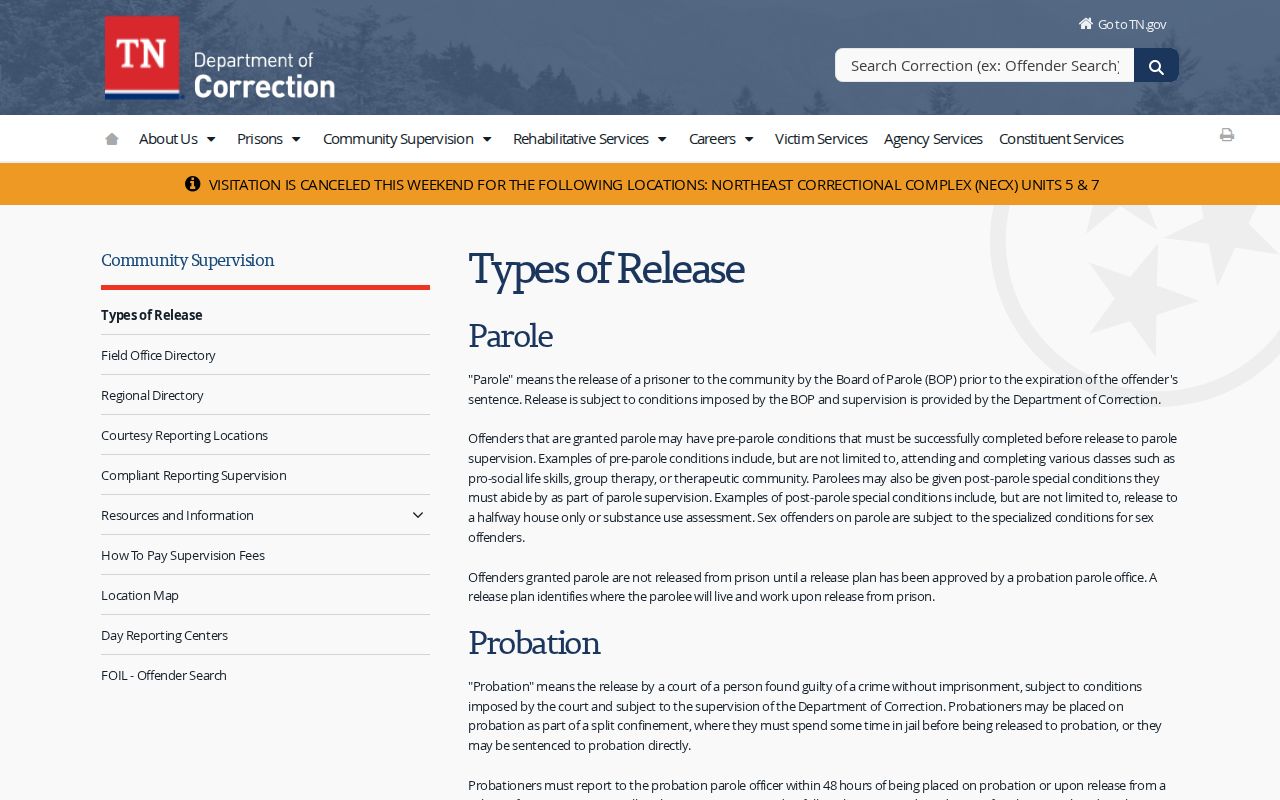
The captured state page helps distinguish supervision categories, while FOIL and District 20 identify the status attached to a specific person.
Sevier Supervision Status Changes
Conditions are the rules attached to the judgment, parole certificate, or release paperwork. They can include reporting to an officer, following location limits, completing treatment, paying court-ordered sums, or obeying other case-specific terms. The controlling paperwork matters. General agency descriptions cannot replace an individual's order.
A reported violation may lead to review, a warrant, a revocation process, continued supervision, or another disposition. It does not by itself prove that the person is back in custody. “Absconded” means the agency alleges the person stopped complying or cannot be found. Sevier County has no verified public person-by-person absconder list. Check FOIL, District 20, and the official warrant or court channel rather than relying on private compilations.
Tennessee SAVIN through VINELink can send custody-status notices, but it is not a supervision-discharge registry. County jail and TDOC feeds may show different stages. An alert should be confirmed through the agency that generated the event.
Sevier County Supervision Discharge
Supervision ends through formal agency or court action, not merely because a person no longer appears in one search. A parole file may reach sentence expiration or another authorized discharge. Probation may end upon completion, an order of discharge, or a later court action. Mandatory reentry supervision under T.C.A. § 40-35-506 has its own statutory framework and should not be relabeled as ordinary probation or parole.
For documentary proof, request the specific record that closes the obligation. The originating court maintains probation orders and later case entries. TDOC maintains its custody and supervision history. The Board maintains parole files and final notices. FOIL may show an inactive status, but the detail and dates should be read before treating that label as a full explanation.
A registry record is separate. The Tennessee sex-offender and drug-offender registries arise from specific statutes and do not prove when parole or probation ended. Likewise, release from supervision does not erase the underlying court record unless a lawful expungement or other order changes official access.
Note: Ask for a discharge order or agency status history when an “inactive” result does not explain how supervision ended.
Which Sevier Releases Reach District 20?
District 20 is the distinctive local route documented for state supervision. It does not handle every person who leaves the Sevier County Jail. An ordinary county-only booking that ends on bond, dismissal, or time served may have no TDOC supervision record. A felony sentence, parole release, covered probation order, determinate release, or mandatory reentry status can create the state connection.
Custody location and legal custodian can overlap. TDOC's dated jail snapshot identified state-backed prisoners at both the Sevier County Jail and Jail Annex. A person can therefore be physically housed by SCSO while the sentence relationship is tied to TDOC. Search the current SCSO roster for current local custody, FOIL for the state relationship, and the court judgment for the authority.
When the person left one agency under a detainer, “released” may describe a transfer into another jail or system. Confirm the receiving agency before concluding that community supervision began. District 20 is the key local route for Sevier County post-release supervision.
The Tennessee Board of Parole and TDOC also have separate roles. Board hearing schedules are updated on Monday, or Tuesday after a Monday holiday, but the agency warns that schedules may change. A schedule can list a TDOC number, name, hearing type, date, and facility. It is not the final result. A hearing officer makes a nonbinding recommendation, and Board members make the decision under the voting rules that apply to the case.
Possible outcomes include a grant, denial, deferral, revocation, reinstatement, or rescission. The final notice is stronger evidence than the calendar. No public person-by-person Sevier County decisions database was verified. FOIL may show hearing status, while Board Operations maintains files and notices. A Board records request or the proper institutional probation and parole officer is the fallback for an authorized inquiry.
Determinate release adds another local distinction. TDOC describes it for qualifying felony sentences of at least one year but not more than two years after at least 30 percent is served, subject to notice and objection rules. Mandatory reentry supervision under § 40-35-506 can place an eligible person in the community for the final year or impose a year of supervision after sentence expiration in specified circumstances. Neither status should be guessed from a roster exit.
County and state notification records should also be kept apart. Tennessee SAVIN covers participating jail and TDOC feeds, but each result belongs to a named custodial agency. TDOC's own detainer-release form directs recipients to SAVIN when a state offender is sent to a Tennessee county facility. The event closes one custody stage while another begins. District 20 can confirm state supervision only when the person is actually assigned to that form of community oversight.
Public Record Search
Sponsored Results