
Sevier Scheduled and Actual Release
A scheduled or computed date is based on the judgment, sentence structure, jail credit, statutory eligibility, and credits that apply at that point. Actual release is the recorded event when one agency relinquishes custody. These dates may match, but they answer different questions. Release eligibility is only the earliest point at which parole consideration may occur. It is not a promise that the Board will grant parole or that an institution will release the person that day.
Pretrial detention is different. No final sentence has been imposed, so there is no sentence-expiration calculation. Bond action, dismissal, a plea, trial, a detainer, or a transfer can change custody. For a short Sevier County sentence, the court judgment and SCSO custody record are the sound sources because no county-specific public good-time chart or weekend-release policy was verified.
Find a Sevier Release Date
Start with the legal custodian, not just the building. The Sevier County Jail and Jail Annex hold local detainees, but they can also house state-backed prisoners. A Sevier conviction can send a person to any TDOC institution. No state prison was identified within Sevier County, so a county name search cannot stand in for the statewide record.
- Identify whether the person is pretrial, serving a county sentence, state-sentenced, or in federal custody.
- For a state felony, search TDOC FOIL by name, TDOC ID, or State ID. Match several identity fields.
- Copy the exact status and date labels. Do not rename an eligibility date, sentence expiration, or past release date as a projected date.
- For county custody, request the judgment from the proper Sevier court and ask SCSO Records for the release or custody transaction.
- For a disputed state calculation, contact TDOC Records Management and request the sentence or time-accounting record.
The Sevier County release record and search overview explains how to trace a roster exit that may be a discharge or an agency transfer.
The official FOIL search form shows the statewide name and identifier entry route.
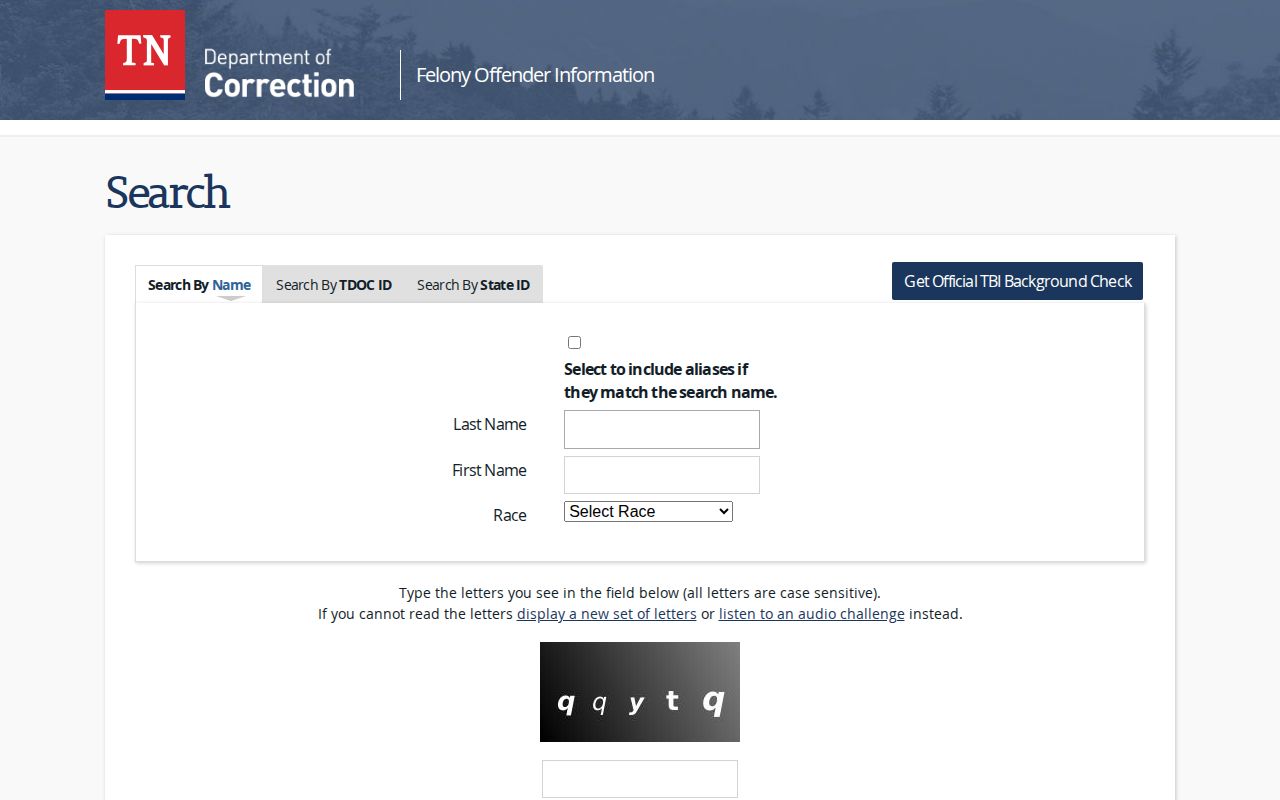
The captured form confirms how a search starts, while a matched detail and agency record must supply the actual date label and calculation.
Note: A missing SCSO roster entry does not establish a release date or prove release to the community.
Tennessee Release Date Calculation
Tennessee calculation begins with the judgment. Key inputs include the offense, offense date, sentence length, offender range, mandatory minimum, consecutive or concurrent structure, and pretrial jail credit. Concurrent terms run at the same time. Consecutive terms run one after another. TDOC is the official timekeeper for state felony sentences, including qualifying state sentences served in a local jail.
T.C.A. § 40-35-501 contains offense-date and offense-specific rules. General release-eligibility percentages in subsections (b) through (f) include 20 or 30 percent for especially mitigated offenders as stated in the judgment, 30 percent for Range I, 35 percent for Range II, 45 percent for Range III, and 60 percent for career offenders, with credits applied only where the law permits. Subsection (m) separately calculates each offense and adds ineligibility periods for consecutive sentences.
There is no universal 85-percent rule in Tennessee. Subsection (y) applies that treatment to specified offenses and distinguishes offenses committed from July 1, 2021 through June 30, 2024 from those committed on or after July 1, 2024. Other subsections impose separate structures and exclusions. The offense date and exact subsection must be checked before applying any percentage.
Sevier Sentence Credits and Dates
T.C.A. § 41-21-236 authorizes up to 16 days per month in the relevant framework: up to eight for good institutional behavior and up to eight for satisfactory program performance. Eligibility depends on offense and sentence dates. The statute also reaches felons serving at least one year in local jails or workhouses under subsection (d). Documented presentence good behavior and misdemeanor local credits have separate provisions.
Credits can affect release eligibility or another date without changing the sentence imposed by the court. For qualifying post-July 1, 2024 sentences of two years or more, § 40-35-501(ff) generally makes credits affect parole eligibility rather than sentence expiration, with the balance served on parole if release occurs. That distinction is a strong reason to preserve FOIL's exact field labels.
No Sevier-specific credit chart was found. Do not import another Tennessee county's practice. For a county sentence, ask SCSO how the judgment and lawful credits were entered. For a state sentence, TDOC's time-accounting record controls the calculation.
Why Sevier Release Dates Change
A future date is a calculation from facts known at the time. Later credits, discipline, a corrected judgment, or another custody claim can move the outcome. The reason should be confirmed in the source record rather than inferred from a changed public display.
A changed date does not always mean an error. Compare the old and new labels, then ask which judgment, credit entry, Board action, or detainer produced the revision.
| Factor | Effect | Best source |
|---|---|---|
| Earned or lost credits | May adjust an eligible calculation | TDOC or jail computation |
| Corrected jail credit | Changes time credited toward the sentence | Judgment and computation |
| New court order | May alter sentence length or term structure | Originating court |
| Detainer or hold | May turn release into a transfer | Releasing and receiving agencies |
| Parole action | Grant, denial, deferral, rescission, or revocation changes the path | Board notice and TDOC |
| Data correction | Fixes a source entry or recalculation | Source-record agency |
Confirm Sevier County Release Dates
FOIL supports preliminary state checks, but TDOC warns that its public data may not be complete, timely, or error-free. The stable search form provides name, TDOC ID, and State ID modes, yet the exact future-date label could not be verified through a controlled result because the CAPTCHA blocked that capture. Copy what the live person detail actually calls the date. Never supply a generic field name that the record does not use.
For a completed county event, ask SCSO Records for the booking or custody history, actual release date and time, release disposition, and receiving agency if the event was a transfer and the field is public. The Sevier court judgment explains sentence authority but usually does not prove the door-out time. For state records, TDOC archived records can supply a more formal sentence or status history.
Tennessee SAVIN through VINELink can provide an alert when a participating agency reports a status change. An alert is not the final record. The Sevier County VINE inmate check should be followed by a call to SCSO, TDOC, or the receiving agency.
Note: FOIL status, court authority, and the release transaction should agree before a projected date is treated as completed.
Sevier Date Lookup by Custody
Each channel covers a different population. The SCSO roster is current-custody oriented and has no verified release-date or release-reason field. FOIL covers current and former TDOC custody or supervision. The Board hearing schedule lists hearings, not guaranteed exit dates. BOP's locator may publish projected or past federal dates, while ICE's locator answers a separate current or recent immigration-custody question.
A state inactive status should be read with the sentence and release detail. A parole status means supervision is active, not unconditional discharge. A Board schedule may change and does not prove that release occurred. A county roster disappearance may be bond, time served, dismissal, transfer, or another event. Matching the system to the legal custodian prevents a date from one stage being mistaken for freedom from all agencies.
The documented Sevier-specific gaps shape the calculation route: no county chart, no verified weekend policy, and no confirmed generic projected-release label. FOIL, the judgment, and the responsible timekeeper must fill those gaps.
Federal sentence dates use a different path. The Bureau of Prisons locator searches by federal identifier or name and can show a release date and location. A past date with no facility means the person is no longer in BOP custody, but supervision or custody by another agency may still exist. Federal pretrial movements are often managed by USMS and may not appear like a sentenced BOP record.
An ICE detainer also changes how a county event is read. The detainer asks the local agency for notice and up to 48 added hours so ICE can assume custody. If SCSO transfers the person, the county event can have an actual release timestamp even though the person did not return to the community. Use the receiving system to confirm the next stage.
The same caution applies to parole. The Board publishes hearing calendars, and a favorable decision can still precede release-plan approval and institutional processing. The final Board notice, FOIL status, and TDOC release transaction must be read together. Eligibility, a hearing date, and physical release should never be collapsed into one projected date.
Sevier court records add the judgment detail that FOIL cannot replace. General Sessions handles misdemeanors and preliminary felony proceedings, while felony prosecution and disposition can proceed through Circuit or Criminal Court. Municipal matters may remain with a city court. Give the clerk the arresting agency, approximate arrest date, charge, and case or citation number when known. Ask for the judgment and any amended order, not a verbal date estimate alone.
A judgment can show sentence length, ordered credits, probation terms, and whether terms run together or in sequence. A later revocation, satisfaction, or amended order may change the calculation. The court authorizes the sentence, but TDOC or SCSO applies the custodial computation for the population it holds. When the public dates conflict, request both records and identify the exact field in dispute.
For TDOC documentation, the archived-record route accepts a precise request with the full offender name, TOMIS or TDOC number, date of birth, and record description. Written requests go to TDOC Records Management at the Rachel Jackson Building, second floor, 320 Sixth Avenue North, Nashville, TN 37243-0465. Questions can be directed to (615) 253-8079. Archive-search charges may apply, and TDOC advises requesters not to prepay.
A useful request names the sentence computation, custody and status history, release authorization or discharge sheet, and the exact date fields at issue. Ask for an electronic copy and an estimate. If a portion is withheld, ask the custodian to identify the basis. This record-based route is more reliable than attempting to calculate the date from a charge name or sentence length alone.
Public Record Search
Sponsored Results